If you are a freelancer, you need to register with BIR as a self-employed professional to pay your taxes and get a copy of your income tax return (ITR) for other purposes. Here are the simple steps to do it.
•These are listed in chronological order based on my experience.
First, the requirements
- Government-issued ID
- Occupational tax receipt (OTR)
- BIR Form No. 1901
- BIR Form No. 1906
- BIR Form 1905*
- Book of journals (journal and ledger)
- Final and clear sample of principal receipts/invoices (if you have these)
This post is for freelancers, but here are some additional documents needed if you are a businessperson (single proprietor):
- Mayor’s business permit (photocopy) or duly received application for mayor’s business permit (stamped “received”) if the former is still in process
- DTI certificate
*IMPORTANT:
If you were previously employed, you likely have a tax identification number (TIN) already. Check which revenue district office (RDO) you are currently registered at. If it is different from where you will be paying taxes now, fill out a Form 1905 to update your RDO code.
Do this A WEEK BEFORE you start the whole registration process.
Where: Your RDO (where your old company paid taxes, if you were previously employed)
Fill out a Form 1905 and have it received and stamped.
If you are changing RDOs within the same region, update occurs within the day. If your old RDO is located in another region, it might take a few days for the information to be updated in the system. Once updated, you can now go to your new RDO and complete your registration there. You can ask them to check their system if your TIN shows your new RDO code.
What’s this for?
As a freelancer, you need to pay taxes at the RDO with jurisdiction over your valid address. If you were previously employed and your company paid taxes in Muntinlupa, but you lived in Las Piñas, you need to transfer to the Las Piñas RDO and change your registered address to the one you are using now.
If you were registered in Las Piñas when you were employed and still live in Las Piñas now, then skip Form 1905 and go straight to step 1.
Each RDO has a corresponding code. Remember yours for your own convenience. It’s just a one- to four-digit code, anyway.
1. Prepare your government-issued IDs
Where: NSO, DFA, LTO or barangay hall
Prepare photocopies of your NSO birth certificate and passport, driver’s license or community tax certificate, also known as cedula, showing your name, birth date and address.
I always bring original copies, too, in case they want to verify it.
You only need one photocopy each of your birth certificate and one kind of ID, not all of them. Whew! Had you there, didn’t I?
2. Get an occupational tax receipt (OTR)
Where: Your city treasurer’s office
Get your OTR from the city treasurer’s office, usually at your city hall (munisipyo). If they don’t understand what kind of job you have, just say you need to register as a self-employed professional. The OTR costs around Php100 to Php200; it differs in each city.
An OTR is similar to the professional tax receipt (PTR) issued to professionals, such as doctors, nurses, lawyers, engineers and architects [hint: professions that have a board exam and are thus issued a Professional Regulation Commission (PRC) ID].
The OTR is for consultants, agents, artists, actors, authors, photographers, underwriters and other freelancers (hint: professions that do not have a board exam).
3. Buy your book of journals
Where: Any bookstore
Buy two or three columnar books for bookkeeping purposes. You should have at least one journal and one ledger. BIR will stamp the pages to make them valid. You will record all your transactions here, corresponding with your invoices and receipts.
You can also get your book of journals from BIR (this depends on the RDO). These are already stamped, so no more hassle for you. They cost more than the ones sold at a bookstore, though. Convenience has a price.
4. Fill out Form 1901 and submit your documents
Where: Your local RDO (the new one if you changed RDOs)
Go to your new RDO and fill out a Form 1901 (Application for Registration). If you are registering for the first time, you will be issued a TIN. Please ask a BIR staff if you are not sure about any information required.
A BIR staff will check your documents and determine your taxpayer code. Mine was 7499.
You will also be informed what kind of taxes you need to pay.
When I started out, I had to pay income tax (1701Q and 1701) and percentage tax (2551M; changed to 2551Q). This year, I opted for 8% tax rate, so I will just pay income tax (no more percentage tax). Less hassle.
5. Pay the registration fee (PHP500)
Where: At a BIR-authorized payment center
Get a Form 0605 (Payment Form) from your RDO, fill it out and pay the PHP500 registration fee at your RDO’s authorized payment center.
I pay at BPI or MetroBank, which are close to my RDO. Both banks have limits for accepting BIR payments; for example, BPI accepts payments till noon only and MetroBank accepts the first 100 payments only.
You will need to register your business every year from now on, so you must pay this Php500 registration fee at the start of each year. Deadline of payment for succeeding registrations is the last business day of January.
6. Fill out Form 1906
Where: Your local RDO
Fill out a Form 1906. This is your Application for Authority to Print Receipts and Invoices.
As a registered freelancer, you will now have to issue receipts to your clients. Doesn’t that just make you feel more professional?
You can’t just print your own receipts, though, or even hire “someone you know”. You have to order your receipts from a BIR-authorized printer for these to be valid.
You can ask a BIR staff for a list of authorized printers. The name on your receipt will be your full name because you are a registered professional. It now makes sense why most local businesses just have the owner’s name.
7. Attend the seminar at your RDO
Where: Your local RDO
The seminar lasts a half day (8 a.m. till noon) and is held on a particular day of the week. Ask your RDO for the schedule. You just need to attend it once.
After the seminar, you will get a certificate of attendance.
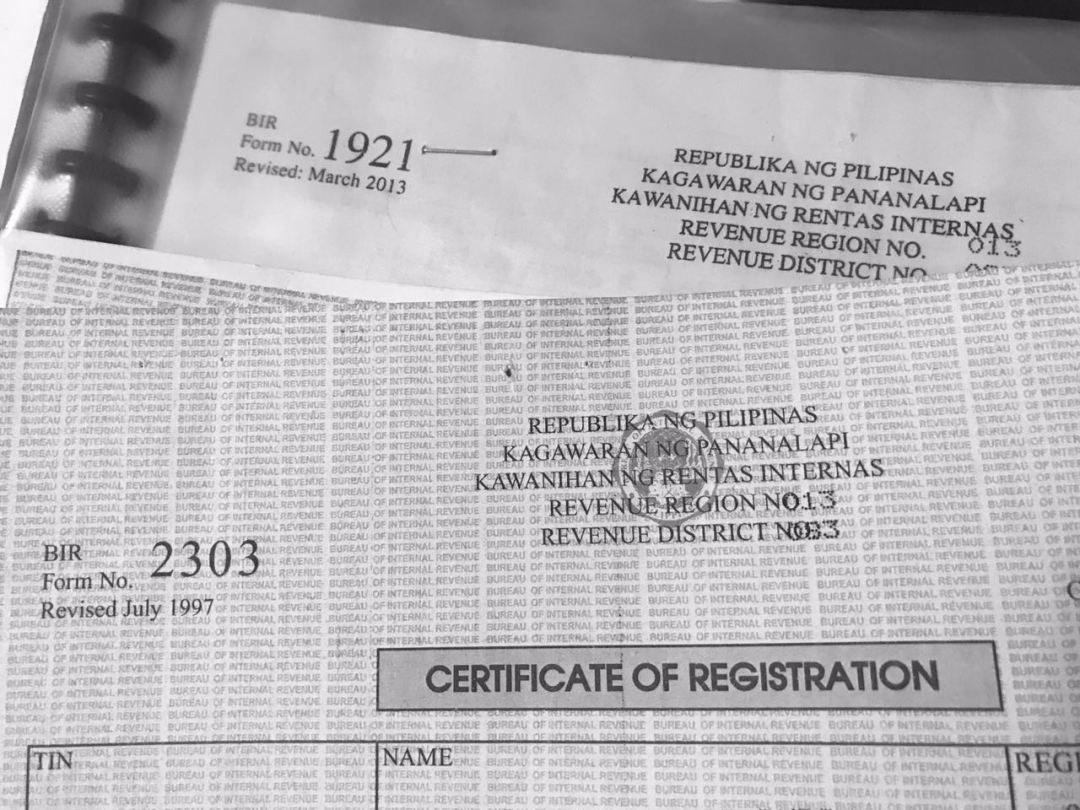
8. Get your Certificate of Registration (COR) or Form 2303
Where: Your local RDO
BIR will then issue your COR, “Ask for Receipt” notice and an Authority to Print (Form 1921).
9. Have your book of journals stamped
Where: Your local RDO
Get your book of journals stamped or buy the already stamped ones at BIR.
10. Print your receipts
Where: Any BIR-authorized printer in your area
- Get a list of authorized printers from your RDO.
- Visit your chosen printer to order your receipt booklets.
- Present your Authority to Print (Form 1921) and Payment Form (Form 0605).
- You might need to order four to six booklets, depending on their minimum order.
I initially ordered four booklets (with 50 sets, 100 leaves each) for a total of PHP600.
That’s it! You can now issue your clients a receipt every time they pay you. Don’t forget to log it in your book of journals.
Congratulations on starting your freelancing career and paying taxes from now on. You have become a more useful member of society. Good job!
TIPS
-If you already have a TIN and need to change your registered address, update your RDO code (Form 1905) a week in advance.
-Get your documents ready before going to your new RDO. You could finish everything in a day if you planned well. Call ahead for the seminar schedule and register on the same day.
-When you go to your RDO, ask the staff for the process of registering as a self-employed professional. They will likely give you a list of requirements and the procedures. Just tick off the documents you already have. Isn’t it nice to come prepared?
-Use eBIRForms to file your taxes. It is very easy and convenient. See my steps on how to file an annual income tax return.
-You will now have to file 1701Q three times and 1701A once a year. The deadlines are:
- 1701Q – Q1: May 15
- 1701Q – Q2: August 15
- 1701Q – Q3: November 15
- 1701A: April 15
If you had opted for percentage tax, you also need to file Form 2551Q four times a year:
- 2551Q Q1: April 25
- 2551Q Q2: July 25
- 2551Q Q3: October 25
- 2551Q Q4: January 25 (the following year)
If you don’t know which is better – 40% OSD or 8% tax rate – read my post to help you decide.
 Astrid Abella